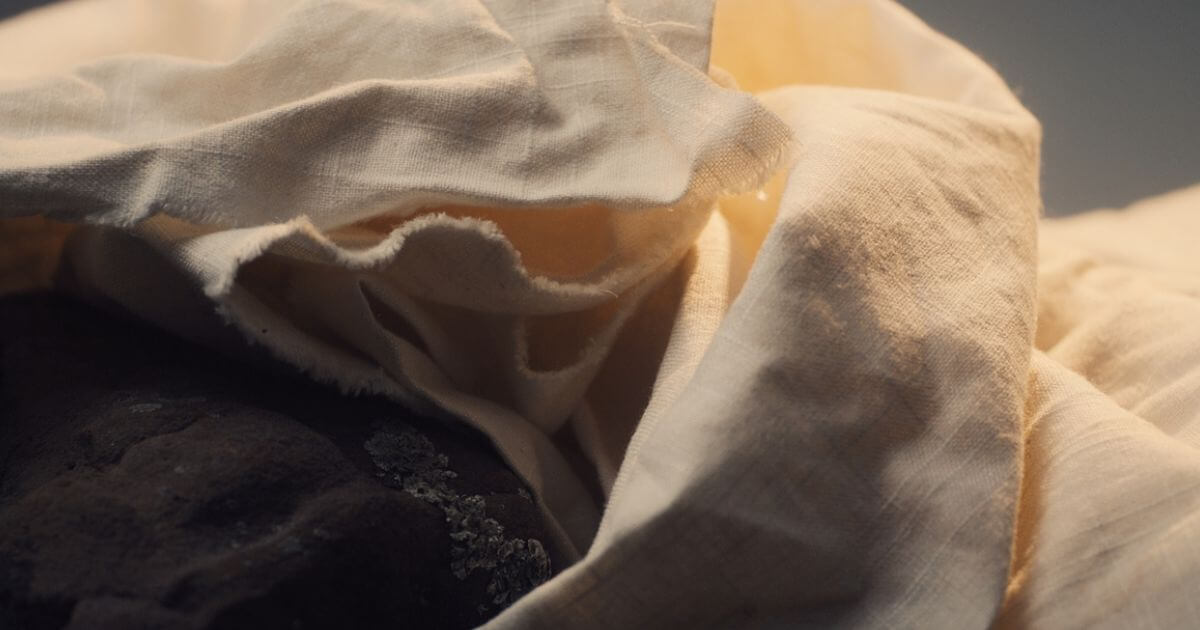
Jesus was taken from the cross in a cloth (Matthew 27:59; Mark 15:46; Luke 23:53). More than 1,300 years later, a cloth was "discovered" and thought to be Jesus' burial cloth. It is located now in Turin, Italy, and is referred to as the Shroud of Turin. The Shroud of Turin shows markings that indicate whoever was buried in it had been crucified. There are also markings around the head, back, and legs consistent with torture.
The cloth used on Jesus' body as it was taken from the cross was a whole piece of linen (Matthew 27:59). When the body arrived at the tomb of Joseph of Arimathea it was likely washed and rewrapped. Then "strips of linen" or "linen cloths" (Luke 24:12; John 20:5–7) were seen in the empty tomb. We know there were at least two pieces of linen: one for Jesus' head and at least one for His body. The Shroud of Turin is in one piece, showing the wounds from head to foot. This discrepancy seems to dispel the idea that the Shroud of Turin is the burial cloth of Jesus.
The Shroud of Turin, though intriguing, is highly unlikely to be the burial cloth of Jesus. The Gospel accounts of Jesus' burial describe Him being wrapped in a clean linen cloth (Matthew 27:59), and later in separate linen cloths, including a distinct face cloth (John 20:6-7). However, the Shroud is a single piece of cloth, which contradicts these specific descriptions. Additionally, scientific tests, including carbon dating, have dated the Shroud to the medieval period, long after Jesus’ time. While the Shroud remains a fascinating mystery, it does not align with the biblical record, leaving it highly improbable that it is Jesus' burial cloth.
Despite the uncertainty surrounding relics like the Shroud, there is abundant and compelling evidence to trust in the truth of Jesus' resurrection. First, the multiple, consistent eyewitness testimonies found across the Gospels provide a strong foundation for the resurrection. These Gospels were written by individuals who were either direct witnesses or closely associated with those who were, and they consistently affirm that Jesus appeared alive after His death. Second, the empty tomb itself—guarded by Roman soldiers and later discovered empty by Jesus' followers—serves as a powerful testimony. The fact that no physical body was ever produced, even by Jesus' enemies, further supports the claim that Jesus rose. Third, the dramatic transformation of the disciples from fear to bold proclamation offers compelling evidence. Before the resurrection, they were in hiding, but after encountering the risen Jesus, they courageously spread His message, often at the cost of their own lives. Their willingness to suffer and die for their testimony speaks volumes about the truth of what they experienced. Finally, the rapid growth of Christianity, a movement that began as a small and persecuted sect, can be attributed to the belief in a resurrected Savior. This explosive growth would be difficult to explain without the resurrection being a central, undeniable reality.
As we reflect on these pieces of evidence, we are invited to trust in the resurrection of Jesus, not because of physical relics or artifacts but because of the unwavering testimony of those who lived and died for what they saw and believed. Jesus' resurrection offers hope, and it is this foundational truth that we can build our lives upon. The risen Christ conquered sin and death. May that truth anchor and guide our lives today.
 Facebook
 Twitter
 Pinterest
 Email
Email